
Organized network cabling for Orange County workplaces
Build a Documented Physical Foundation for Business Connectivity
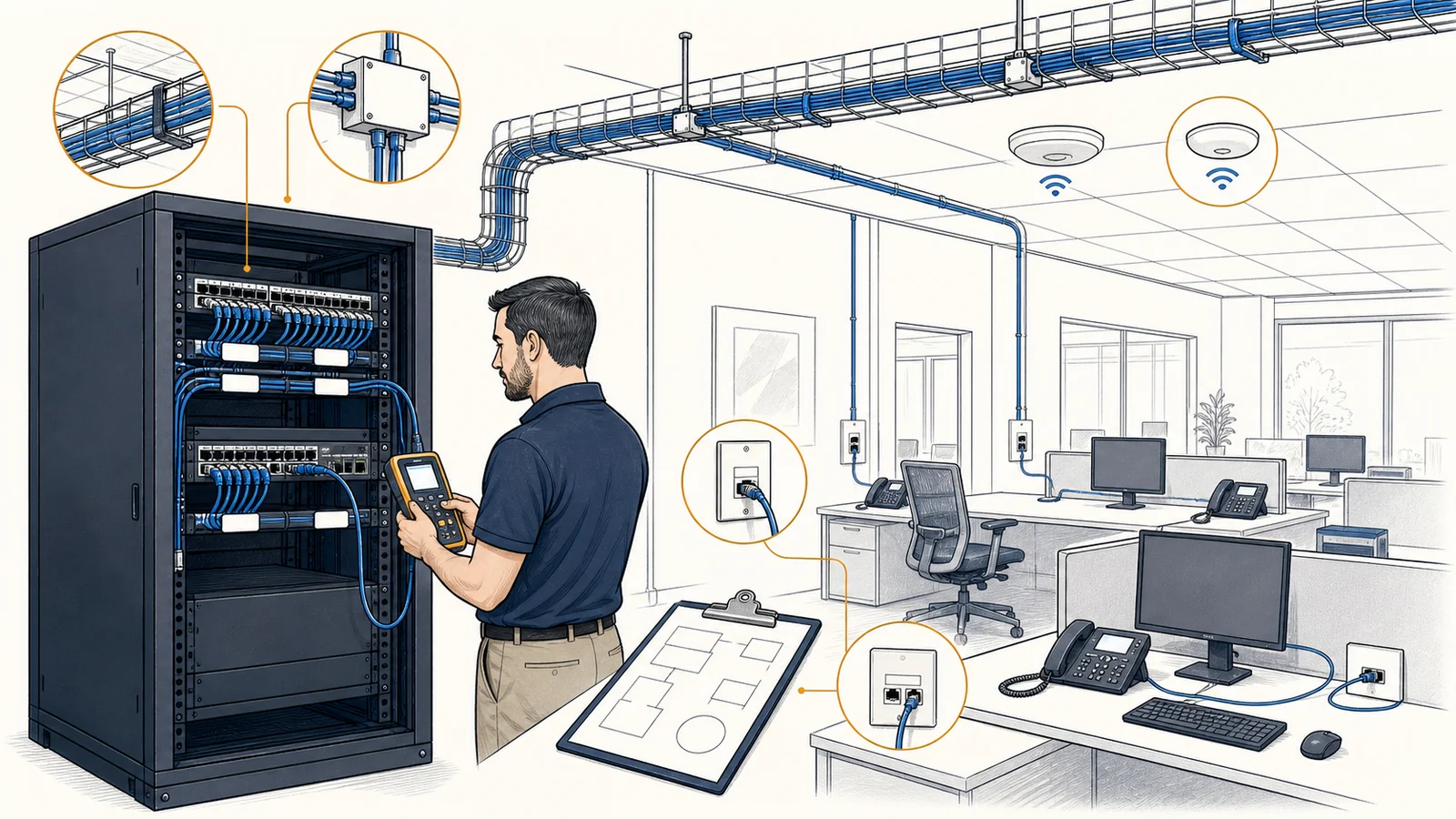
Structured cabling connects work areas, wireless access points, VoIP phones, cameras where applicable, switches, and other approved network devices to an organized telecommunications space. The value is not simply cable inside a wall. Useful infrastructure requires suitable pathways, category and component selection, distance control, proper termination, patch panels, racks or cabinets, labeling, testing, and records that help future technicians identify each run.
Apex IT Solutions helps Orange County businesses assess and scope low-voltage data-cabling work for offices, warehouses, retail spaces, professional facilities, and light-industrial environments. Work is planned around the building, network design, device locations, switch and Power over Ethernet requirements, landlord rules, other trades, and the type of test result the customer needs. Electrical, fire-alarm, access-control, and life-safety work are not represented as part of this service.
Plan New Runs and Investigate Physical-Layer Warning Signs
An office buildout, added employees, relocated departments, new access points, VoIP deployment, network-camera project, or warehouse reconfiguration can create a need for data outlets and rack capacity. Existing environments may also show intermittent link drops, ports negotiating below the expected rate, damaged faceplates, loose jacks, unlabeled patch cords, abandoned runs, crowded cabinets, or a cable plant that no longer matches the floorplan.
Office Buildouts
Floorplans, furniture, equipment rooms, wall and ceiling construction, work-area counts, carrier handoffs, and move dates should be reviewed before outlet locations and pathways are approved.
Moves, Adds, and Changes
New desks, relocated equipment, added phones, and revised workflows may require new runs, re-termination, patching, labeling, or removal from service. Existing records should be updated with the change.
Wireless and VoIP
Ceiling access points and VoIP phones need suitable Ethernet links and may depend on PoE. Access-point placement should follow the wireless design, not merely the easiest available cable path.
Network Cameras Where Applicable
Approved IP-camera locations may require data cabling, PoE, switch capacity, retention infrastructure, network policy, safe mounting coordination, and property authorization. This service does not include residential surveillance or access-control systems.
Select Cat5e, Cat6, or a Separately Evaluated Cat6A Design From Requirements
Cat5e and Cat6 are recognized balanced twisted-pair cabling categories used in business networks. Selection should consider the intended Ethernet application, supported distance, installation environment, pathway space, bend and pulling constraints, patching, existing components, switch interfaces, equipment lifecycle, and test requirement. Cat6 generally has tighter transmission-performance specifications than Cat5e, but installing Cat6 does not by itself establish the internet speed, application performance, or network throughput a user will receive.
A channel includes more than the horizontal cable. Jacks, patch-panel terminations, patch cords, consolidation points where used, workmanship, length, and the surrounding electromagnetic environment all affect results. Mixing components or retaining unknown patch cords can change the tested channel. The internet circuit, firewall, switches, device network adapters, servers, wireless links, and applications may be the limiting factor even when a cable run passes its defined test.
Cat6A may warrant separate evaluation for applications and designs that need its performance characteristics, including certain longer-distance high-speed copper links or environments with relevant alien-crosstalk concerns. It is larger and can change pathway fill, bend radius, termination, rack density, patching, and labor considerations. It should not be substituted into a scope without checking the entire channel and physical environment.
Coordinate Pathways, Telecommunications Spaces, and Work-Area Components
Cable pathways may use approved trays, conduit, sleeves, supports, raceway, or other building-appropriate routes. Above-ceiling conditions, wall construction, fire-rated assemblies, return-air spaces, structural obstacles, elevators, machinery, lighting, and electrical systems can constrain the route and cable type. Paths need safe supports, controlled tension and bends, and separation from interference sources. Field conditions may require revised routes and coordination with landlords, electricians, contractors, or building management.
At the telecommunications space, horizontal runs commonly terminate on patch panels in a rack or cabinet. The design should account for usable rack units, mounting depth, cable management, switch placement, patch-cord lengths, service loops, airflow, power, UPS needs, grounding or bonding responsibilities, physical access, and room conditions. A neat rack cannot compensate for insufficient electrical service or cooling, and data-cabling work does not include electrical installation unless separately performed by an appropriately authorized trade.
At the work area, faceplates, jacks, surface boxes, and labels should match the planned outlet count and environment. Warehouse columns, retail fixtures, production spaces, dust, vibration, washdown areas, and exposed pathways can require different protection than a standard office wall. Final locations must be approved against furniture, doors, shelving, machinery, accessibility needs, and the devices that will connect.
Match Cabling to Switch Ports, PoE, Devices, and the Network Design
A terminated run provides a physical path; it does not assign an IP address, configure a VLAN, deliver internet service, or make an application available. The connected switch needs the appropriate port interface, configuration, uplink capacity, firmware support, licensing where required, and available ports. The wider network may depend on DHCP, DNS, routing, firewall policy, internet service, and servers. These items belong to the business network design even when they are coordinated with cabling.
Power over Ethernet can carry data and power on supported links for access points, phones, cameras, and other compatible devices. The device, switch or injector, cable, connectors, link length, PoE standard, per-port capability, and total switch power budget must be compatible. Higher power and bundled cabling may add design and temperature considerations. A cable that supports continuity is not proof that the power budget or device configuration is correct.
For business Wi-Fi, cable endpoints should align with the approved access-point design, mounting method, and switch plan. Adding a jack in the center of a room does not establish coverage or capacity. Apex can coordinate physical connectivity with business Wi-Fi planning so cable routes, PoE, and access-point placement are considered together.
Specify the Test Needed and Preserve Results With Clear Labels
Basic wiremap or continuity testing can identify conditions such as opens, shorts, reversals, or split pairs, depending on the tester. It is useful for checking conductor connectivity, but it does not establish that a link meets all transmission requirements of a category or application. A live-network qualification tool may assess whether an installed link can support selected network technologies, yet qualification is still different from standards-based category certification.
Certification testing uses an appropriate calibrated field tester, the selected test limit, correct adapters, and documented results to evaluate defined parameters for a permanent link or channel. The scope should state whether the customer needs continuity, qualification, certification, or targeted troubleshooting; which links are included; the category and test limit; permanent-link or channel configuration; treatment of failures; and delivery format for results. The word “certification” here describes the test result and method, not an unverified company credential.
Labels should provide a unique identifier at the patch panel and outlet, follow a consistent scheme, and correspond to records the customer can use. Documentation may include outlet locations, panel and port assignments, cable identifiers, test status, exceptions, rack elevations, pathways at a useful level, change notes, and as-built floorplan references when included. Records should not publish passwords or other sensitive administrative credentials.
Clarify Installation Scope, Exclusions, and Customer Responsibilities
A Defined Data-Cabling Project May Include
- Requirements, floorplan, outlet, device-location, pathway, and telecommunications-space review
- Specified Cat5e, Cat6, or separately evaluated Cat6A components for approved runs
- Approved supports, horizontal cable, patch panels, jacks, faceplates, and cable management
- Termination, labeling, patching, and testing to the stated method and limit
- Moves, adds, and changes to identified network runs
- Defined test reports, port schedules, exceptions, and as-built documentation
It Does Not Automatically Include
- Electrical circuits, outlets, panels, lighting, grounding, or other electrical-contracting work
- Fire alarm, life-safety, access control, door hardware, locks, badges, or residential systems
- Permits, engineering, architectural work, hazardous-material work, core drilling, trenching, lifts, or construction repair
- Switches, routers, firewalls, UPS equipment, internet service, VoIP service, cameras, licenses, or configuration
- Reuse of unidentified or damaged existing cable without assessment and testing
- A particular application speed based only on the category printed on the cable
The customer is responsible for accurate floorplans and device counts, access to approved work areas, landlord and building-management coordination, property authorization, safe scheduling, furniture and equipment decisions, and timely approval of changes. Permitting, inspection, firestopping, licensed-trade, or specialist requirements depend on jurisdiction, building, route, and scope; they must be determined rather than assumed unnecessary.
A Practical Cabling Assessment and Implementation Process
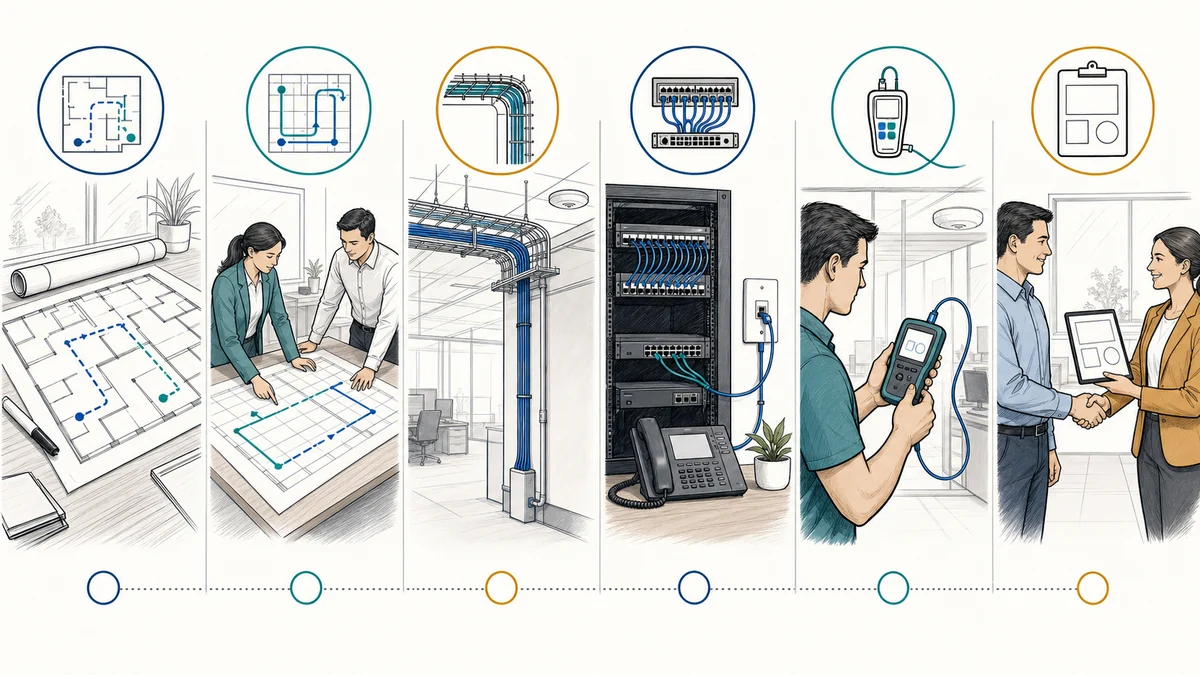
- Define business requirements. Identify work areas, network devices, phones, access points, applicable cameras, equipment rooms, expected changes, move dates, test requirements, and documentation needs.
- Inspect the site. Review floorplans, pathways, ceilings, walls, telecom spaces, racks, existing cable, electrical and interference constraints, access, working conditions, and coordination needs.
- Develop the scope. Specify run endpoints, category and components, pathway assumptions, racks or cabinets, patch panels, jacks, labels, test method, exclusions, dependencies, and responsible parties.
- Coordinate approvals. Confirm landlord or property requirements, building access, other trades, permits or inspections where applicable, safety constraints, schedule, change process, and protection of occupied work areas.
- Install and terminate. Route, support, protect, terminate, dress, and label approved runs according to the defined design and observed field conditions. Unforeseen route changes require review.
- Test and correct. Test each scoped link using the stated method. Investigate failures, correct work within scope, retest affected links, and record unresolved third-party or existing-infrastructure conditions.
- Document and hand off. Deliver agreed labels, port schedules, test records, floorplan or pathway notes, exceptions, and change information so future network work begins with usable evidence.
Adapt the Cabling Plan to the Business Environment
Professional offices often prioritize work-area density, conference rooms, clean faceplate locations, occupied-space scheduling, and future moves. Warehouses may add long pathways, high ceilings, lifts, metal racking, changing inventory, dust, and access-point placement constraints. Retail environments may have fixed checkout positions, public areas, limited back-room space, and strict work windows. Light-industrial spaces can add machinery, electrical noise, vibration, physical protection, and safety coordination.
Medical and other professional workplaces may have specialized vendor equipment, privacy procedures, and room-access constraints. Cabling does not determine regulatory status, and Apex does not provide legal or compliance certification through this page. The project should identify operational restrictions and coordinate with the customer’s responsible advisers and equipment vendors.
Structured Cabling for Orange County Business Locations
Apex IT Solutions serves businesses and organizations in Anaheim, Irvine, Santa Ana, Costa Mesa, Fullerton, Brea, Buena Park, and other Orange County locations where work is operationally available. Commercial buildings vary in management rules, ceiling systems, pathways, telecom rooms, construction, access schedules, and contractor requirements. An onsite assessment helps identify those conditions before the run count and installation approach are finalized.
For an occupied office, upcoming move, warehouse change, wireless expansion, or network cleanup, provide the location, floorplan, desired endpoints, device types, timing, current rack or cabinet information, known cable issues, and building contacts. The initial review can separate data-cabling needs from network configuration, electrical work, and other contractor responsibilities.
Structured Cabling FAQs
Should our business install Cat5e or Cat6?
The answer depends on the intended network application, supported distance, existing infrastructure, pathway and termination conditions, device lifecycle, budget, and test requirement. Cat6 has tighter transmission specifications, but category alone does not determine internet or application performance. The full channel and active equipment must be considered.
When should Cat6A be evaluated?
Cat6A may fit designs that require its performance characteristics, including certain longer-distance high-speed copper links. Its larger cable and connectivity can affect pathway fill, bend radius, termination, rack density, and cost. It should be assessed as a complete system rather than chosen from the name alone.
Can existing network cable be reused?
Possibly, after identifying the cable and components, inspecting condition and pathways where accessible, confirming endpoints and length considerations, and performing the appropriate test. Unknown labels, damage, poor terminations, unsuitable category, abandoned routes, or failed results may make reuse impractical.
What is the difference between continuity testing and certification testing?
Continuity or wiremap testing primarily checks conductor connectivity and faults such as opens, shorts, reversals, or split pairs, depending on the tool. Certification testing measures a defined set of transmission parameters against a selected standards-based limit and produces documented pass or fail results for the tested link configuration.
Does Cat6 cabling provide a specific internet speed?
No. A properly installed and tested channel can support applications within its design limits, but user results also depend on the ISP service, firewall, switches, network adapters, servers, Wi-Fi, configuration, remote service, and traffic. Cable category is only one dependency.
Can cabling be installed for wireless access points and VoIP phones?
Yes, when included in the approved scope. Locations should follow the wireless or phone design, and the switch must provide compatible ports, VLANs, uplinks, and PoE standard and budget where needed. Cabling does not include phone service or wireless design unless listed.
Do you perform electrical, fire-alarm, or access-control work?
No such work is represented by this page. Electrical circuits, fire alarms, life-safety systems, access control, door hardware, locks, and badge systems are outside this structured data-cabling scope. A project may require coordination with appropriately authorized contractors.
Can a commercial cabling installation proceed without a permit?
That cannot be assumed. Requirements can vary by jurisdiction, building, pathway, occupancy, fire-rated assembly, and project scope. The customer, property team, contractors, and relevant authority should identify permits, inspections, firestopping, or licensed-trade responsibilities before work proceeds.
What information helps start a cabling assessment?
Provide the Orange County address, floorplan, outlet and device counts, rack or telecom-room details, access-point and phone plans, known cable issues, requested testing, schedule, landlord or building contact, and any occupied-space restrictions. Request a cabling assessment or call (800) 275-6513.
Plan the Runs, Pathways, Testing, and Records Before Installation
Share the floorplan, work areas, device locations, current telecommunications space, building constraints, schedule, and expected test deliverables. Apex IT Solutions can assess the Orange County business environment, identify dependencies and exclusions, and develop a practical data-cabling scope.