
Scoped network risk review for Orange County businesses
Find Actionable Network Security Gaps Before Planning Changes
A business network can accumulate old firewall rules, broad administrative access, flat internal connectivity, unsupported equipment, forgotten remote-access paths, and inconsistent wireless settings. Documentation may no longer match the environment. Each condition deserves context: a setting that is appropriate for one application or site may be unnecessary exposure at another.
Apex IT Solutions helps Orange County businesses examine an agreed network scope, compare observed configurations and practices with stated business requirements, prioritize findings, and build a practical remediation roadmap. The assessment reflects the systems, records, access, and test methods included in the engagement. It is not a promise to identify every vulnerability, and it is not automatically a penetration test, compliance certification, legal opinion, or formal attestation.

Use an Assessment When the Network Has Changed Faster Than Its Records
A network security review can be useful before an office move, acquisition, major cloud or application rollout, firewall replacement, remote-access change, cyber-insurance questionnaire, or wider infrastructure project. It can also establish a baseline after staff or vendors change. The objective is to understand current conditions and decision priorities—not to create urgency around every difference from a generic checklist.
Unknown Internet Exposure
Port forwards, public services, remote-management interfaces, vendor connections, or cloud-managed equipment may lack a current owner or business justification. Discovery still depends on the addresses, devices, credentials, and test authorization included in scope.
Flat or Unclear Segmentation
Employee devices, servers, guest Wi-Fi, phones, printers, management interfaces, and approved specialty systems may share more connectivity than business workflows require. VLAN names alone do not prove separation.
Aging Equipment and Firmware
Unsupported firewalls, switches, access points, or controllers may no longer receive fixes or vendor assistance. A working device can still create lifecycle and recovery risk when replacements, licenses, and configurations are unprepared.
Incomplete Ownership and Records
Missing diagrams, uncertain administrative accounts, absent configuration backups, and undocumented third-party dependencies can delay safe remediation. An assessment identifies these as operational findings rather than guessing at missing details.
Review Architecture, Firewall Policy, and Segmentation Together
The architecture review maps the in-scope internet handoff, firewalls, routers, switches, wireless infrastructure, internal networks, remote sites, important systems, and approved management paths. Available diagrams are compared with device configurations and observable connections where access permits. The review also identifies ownership boundaries: an ISP, landlord, cloud provider, software vendor, or third-party administrator may control part of a business path that Apex can document but not directly change.
Firewall review may examine interface and zone assignments, inbound and outbound rules, network address translation, inter-segment policy, VPNs, remote administration, disabled or temporary rules, object groups, logging selections, and current business ownership. A permitted connection is not automatically safe, and a denied connection is not automatically correct. Rules must be interpreted against application, identity, endpoint, DNS, routing, vendor, and workflow requirements.
Segmentation review considers whether employee, guest, server, voice, management, wireless, and other approved device groups have only the paths they need. Effective separation can depend on switch-port assignments, VLAN trunks, routing, firewall policy, wireless network mappings, authentication, and the configuration of connected systems. The assessment can identify broad or inconsistent paths, but approved changes require impact analysis and representative testing so business applications are not interrupted without preparation.
Examine Remote, Wireless, Administrative, and Public Access Paths
Remote-access review can cover supported user VPNs, site-to-site tunnels, vendor access, gateway settings, assigned network ranges, authentication dependencies, account groups, and account-removal practices. Access should be traceable to a current business purpose and authorized identity. The tunnel itself does not establish that an endpoint, credential, or remote network is trustworthy. Multi-factor authentication and device conditions are reviewed where the selected platform, licensing, and scope support them.
Wireless review may examine business and guest network separation, authentication method, encryption settings, management access, controller or cloud ownership, access-point support status, network-to-VLAN mapping, and whether shared credentials have a managed lifecycle. Radio coverage and interference affect availability, while authentication, segmentation, and wired backhaul affect different parts of the security posture. A security assessment does not promise a full wireless survey unless that work is explicitly included.
Administrative access deserves separate attention because it can change the network itself. The review may identify default or shared accounts, inactive administrators, internet-reachable management, weak access boundaries, missing role separation, untracked vendor access, and dependence on one individual or portal. Credentials are not placed in the assessment report. They should be exchanged and stored through an approved secure method, with ownership and recovery procedures documented separately.
Exposed-service review compares authorized public-facing services and management paths with available configurations and approved discovery methods. Results can be limited by unknown public addresses, upstream carrier equipment, cloud services, filtering, transient devices, or assets excluded from scope. Active probing or disruptive tests require explicit authorization, defined targets, safe test conditions, and sometimes a maintenance window.
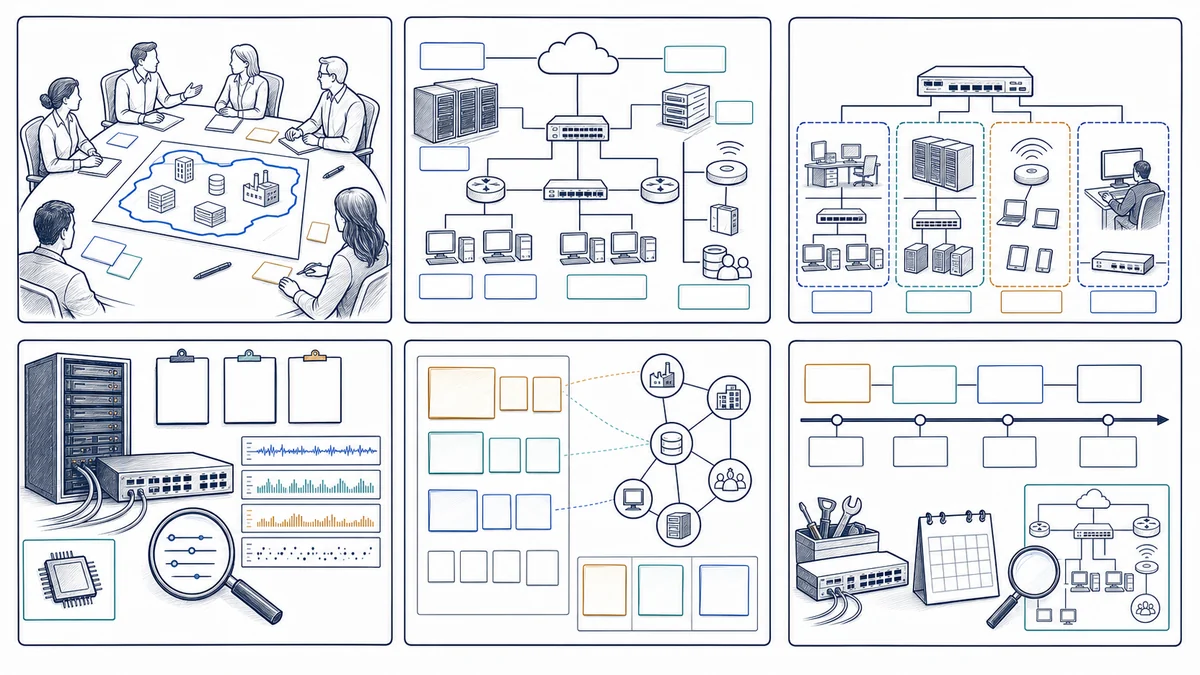
Check Support Status, Configuration Recovery, and Available Visibility
Hardware and firmware review records make, model, role, current version where available, vendor support status, licensing dependencies, update path, capacity concerns, and replacement constraints for approved devices. Installing firmware is not an automatic assessment action. Updates can affect compatibility, VPN peers, configuration syntax, licenses, restarts, and application traffic, so remediation planning should use vendor guidance, backups, approval, testing, and rollback or recovery options.
Configuration records help restore known settings and explain how the network is intended to work. An assessment may check whether current backups exist for supported devices, where they are protected, who can retrieve them, and whether restoration prerequisites are understood. A configuration export is not the same as a tested device-recovery procedure, spare hardware, or high availability. Sensitive exports can contain addresses, keys, account data, or other details and require controlled storage.
Logs may show firewall decisions, VPN events, administrator changes, wireless authentication, device health, or selected alerts. Their value depends on enabled features, time synchronization, retention, storage, licensing, severity settings, and whether events travel through the observed system. Alert configuration also depends on delivery, recipients, triage ownership, escalation, and response expectations. Finding a log source or notification rule does not imply continuous human review or a staffed security operation.
Documentation gaps are findings in their own right when they impede ownership, change control, support, or recovery. Useful records can include topology diagrams, device and circuit inventory, address and VLAN plans, firewall-rule ownership, remote-access owners, vendor contacts, support dates, configuration-backup references, logging destinations, and known exceptions. Documentation should be proportionate and protected; it should not expose passwords or sensitive configuration in a general business report.
Choose the Assessment Type and Limits Before Testing Begins
A Defined Network Security Assessment May Include
- Interviews, inventory, diagrams, support records, and approved configuration review
- Architecture, firewall, segmentation, remote access, wireless, and administrative-access analysis
- Review of approved public exposure, supported hardware and firmware, configuration backups, logs, and alerts
- Identity, endpoint, application, carrier, vendor, and cloud dependencies that affect network controls
- Prioritized findings with evidence, affected scope, business context, and recommended next actions
- Remediation sequencing and post-change validation for separately approved work
It Does Not Automatically Include
- Penetration testing, exploit attempts, password attacks, social engineering, or red-team activity
- Discovery of every vulnerability or proof that an unobserved weakness does not exist
- Compliance certification, legal or regulatory advice, or a formal attestation
- Source-code review, cloud-application assessment, endpoint forensics, or incident-response services
- Unapproved scanning, disruptive testing, changes outside a maintenance window, or access beyond the named scope
- Automatic remediation, replacement hardware, subscriptions, vendor labor, or third-party fees
A configuration-focused assessment examines documented and observed settings against agreed requirements. A penetration test is a separately planned and authorized exercise that may use more adversarial techniques to test defined targets. One should not be represented as the other. Likewise, a technical assessment can inform a business’s risk decisions, but it does not determine legal obligations or certify compliance with a framework, contract, law, or regulation.
Turn Findings Into Owned, Sequenced Remediation
A useful finding identifies the observed condition, affected in-scope asset or path, available evidence, likely business relevance, dependencies, and a practical recommendation. Prioritization can consider internet exposure, privilege, ease of misuse, affected workflows, unsupported technology, existing safeguards, change risk, and effort. A priority is a decision aid, not a prediction that an event will or will not occur.
The roadmap separates actions that can be handled through configuration from those requiring hardware, licensing, carrier work, identity changes, endpoint remediation, application-vendor participation, or a broader project. Quick wins should not displace prerequisites. Removing a public rule, disabling an account, changing wireless authentication, or segmenting a server can interrupt legitimate access if ownership and test plans are missing.
After approved remediation, validation repeats relevant checks against the changed condition and representative business paths. It records what was tested, the result, exceptions, and remaining dependencies. Validation confirms the selected change under stated conditions; it does not convert a limited review into proof that the whole environment contains no vulnerabilities.
A Controlled Network Security Assessment Process
- Define objectives and authority. Identify business concerns, in-scope locations, networks, devices, public addresses, cloud-managed components, exclusions, authorized contacts, permitted techniques, and timing constraints.
- Collect available records. Gather diagrams, inventories, configurations, account and vendor ownership, support dates, remote-access information, change history, configuration-backup references, logs, alerts, and known exceptions.
- Confirm the observed environment. Compare records with accessible devices, interfaces, segments, wireless mappings, firewall paths, administrative access, and exposed services using approved non-disruptive methods.
- Analyze controls and dependencies. Review network architecture, policy, segmentation, access, lifecycle, visibility, identity, endpoint, application, carrier, and vendor relationships without assuming one control can stand alone.
- Discuss material observations. Confirm business ownership and context, separate verified findings from missing evidence, and avoid treating an undocumented requirement as automatically unsafe or acceptable.
- Prioritize and plan. Provide findings, limitations, recommended actions, responsible parties, prerequisites, maintenance needs, validation steps, and longer-term lifecycle work.
- Remediate only with approval. Scope configuration changes, equipment replacement, licensing, vendor work, identity or endpoint tasks, backups, rollback, communications, and representative tests separately.
- Validate selected changes. Recheck the addressed condition, test intended and blocked paths where appropriate, document residual issues, and set a future review trigger.
Network Security Reviews for Orange County Business Environments
Apex IT Solutions works with businesses and organizations in Anaheim, Irvine, Santa Ana, Costa Mesa, Fullerton, Brea, Buena Park, and other Orange County communities where service is operationally available. Professional offices, warehouses, medical and operational workplaces, and multi-location organizations can have different carriers, equipment, applications, vendors, schedules, and tolerance for interruption. Scope should follow the real environment rather than assume the same checklist fits every location.
Remote review may be appropriate for accessible supported configurations, records, interviews, and approved external observations. Onsite work may be needed to compare diagrams with equipment, inspect racks and carrier handoffs, identify unmanaged connections, or review a network that cannot be reached safely. Either approach depends on authorization, available access, accurate ownership information, and participation from the people who understand important business workflows.
Network Security Assessment FAQs
What is included in a network security assessment?
The exact scope is agreed first. It may include architecture, firewall policy, segmentation, remote and administrative access, wireless security, supported hardware and firmware, exposed services, configuration backups, logs, alerts, documentation, and identity or endpoint dependencies. Findings and limitations should identify what was and was not reviewed.
Is a network security assessment the same as a penetration test?
No. A configuration and architecture assessment generally reviews approved evidence and settings against business requirements. A penetration test is separately authorized and may use more adversarial techniques against defined targets. Penetration testing is not implied by this service and would require its own written scope, methods, safeguards, and approval.
Does an assessment certify our compliance?
No. The review can identify technical observations that may help an organization discuss its own requirements with qualified legal, regulatory, insurance, or compliance advisers. It does not provide compliance certification, legal advice, regulatory interpretation, or formal attestation.
Can the assessment find every network vulnerability?
No. Results reflect the systems, credentials, records, public addresses, locations, time period, and test methods included in scope. Unknown assets, encrypted traffic, unavailable logs, third-party platforms, transient conditions, and excluded systems can limit visibility. A review with no reported findings is not proof that no vulnerability exists.
Will testing interrupt business operations?
Document and configuration review can often be non-disruptive, but active discovery, firmware work, policy changes, segmentation, account changes, or validation may affect traffic or access. Potentially disruptive activity requires explicit authorization, impact review, a suitable window, representative tests, and a rollback or recovery approach.
What happens when unsupported network hardware is found?
The finding should record the device role, available support information, dependencies, exposure, configuration-recovery options, and replacement constraints. The roadmap can prioritize replacement or isolation, but hardware, licensing, vendor services, procurement lead time, and migration work are separate unless an approved proposal includes them.
Can Apex make the recommended changes after the review?
Supported remediation can be scoped after findings are reviewed and authorized. Some work may require a firewall or wireless vendor, ISP, application owner, identity or endpoint administrator, replacement equipment, licensing, or a maintenance window. Changes should include backup, rollback or recovery planning, testing, and documentation appropriate to the risk.
How should we prepare for an assessment?
Provide the Orange County locations, business objectives, network diagrams, device and circuit inventory, firewall and wireless ownership, public addresses, remote-access methods, important applications, vendors, known concerns, support records, change constraints, and authorized contacts. Do not send passwords through an unapproved channel. Request IT Support or call (800) 275-6513.
Define the Network Scope Before You Ask What Needs Attention
Share the locations, business concerns, available diagrams, network and firewall ownership, remote-access methods, important applications, recent changes, and people authorized to provide access. Apex IT Solutions can help define a proportionate assessment, document its limitations, and organize practical next steps for your Orange County business.