
Coordinated connectivity for Orange County businesses with branch and remote sites
Connect Business Locations Around Defined Applications, Security, and Operating Needs
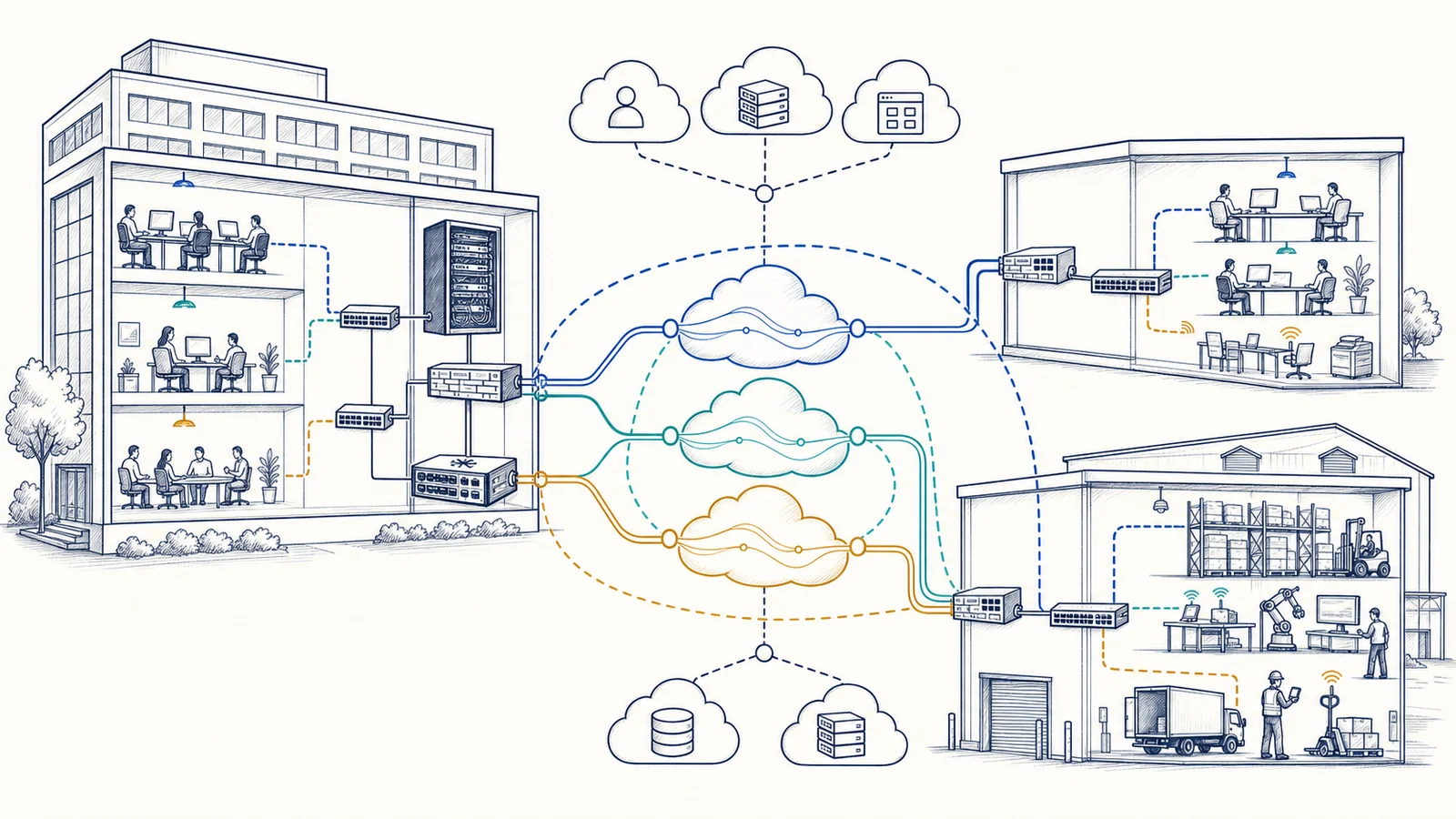
A headquarters, branch office, warehouse, satellite workspace, or acquired company may need access to cloud applications, shared business systems, voice services, identity platforms, and resources at another site. Making those workflows dependable requires more than ordering internet service at each address. Carriers, firewalls, addressing, routing, DNS, security policy, endpoints, applications, and local support responsibilities must work together.
Apex IT Solutions helps Orange County businesses assess, design, implement, document, test, and troubleshoot supported multi-location network connections. The appropriate architecture depends on the locations, available circuits, applications, risk boundaries, equipment, licensing, and operational priorities. Apex does not control carrier uptime, and a second circuit or alternate path does not ensure uninterrupted operation.
Start With the Work That Must Cross Location Boundaries
A useful design begins with workflows rather than a preferred product. Identify which employees, devices, and approved vendors need to reach which applications; where those systems are hosted; how sensitive the traffic is; and what happens when a path is slow or unavailable. A branch that mainly uses browser-based cloud services has different dependencies from a warehouse that reaches a headquarters-hosted inventory application or a satellite office that uses centralized file, print, voice, and identity services.
Branch Access Problems
Users may reach the internet but not a headquarters resource, resolve a server name but fail to open the application, or connect through a tunnel while authentication fails. These patterns require layered testing rather than treating tunnel status as application readiness.
Inconsistent Site Standards
Different subnets, device names, firewall rules, Wi-Fi mappings, administrator practices, and documentation can make routine changes risky. Standards can improve clarity, but site-specific carrier, building, workflow, and equipment constraints still need to be recorded.
Growth and Transition
A new branch, relocation, acquisition, consolidation, or temporary overlap between offices can introduce overlapping addresses, unknown ownership, incompatible equipment, circuit lead times, and application dependencies that should be resolved before cutover.
Unclear Failure Ownership
When a workflow crosses a local network, firewall, ISP, remote gateway, identity service, and application, several parties may own part of the result. Circuit IDs, contacts, diagrams, timestamps, and escalation boundaries make coordination more actionable.
Site-to-Site VPN Is One Architecture, Not the Only Architecture
A site-to-site VPN can create an encrypted path between supported gateways across internet connections. Approved routes determine which network ranges use the tunnel, while firewall policy limits communication between sites. This approach depends on compatible gateways, public-address behavior, supported encryption settings, nonoverlapping internal networks, licenses where required, and administrative control at both ends. A tunnel does not provide the circuits beneath it or make connected endpoints and applications trustworthy.
Some organizations can use direct internet access at each location for cloud applications, with identity, endpoint, DNS, and internet-edge controls applied according to the approved design. Other workflows may require a carrier-provided private network, cloud connectivity service, or another provider-managed path. Those options have distinct contracts, handoffs, routing models, geographic availability, support processes, and costs. Apex can help document requirements and coordinate technical dependencies without representing that one connection type fits each site.
Software-defined wide-area networking, or SD-WAN, is a category that may combine supported edge devices, centralized policy, path selection, and visibility across multiple circuits. It requires an appropriate design, compatible hardware or virtual appliances, licensing or subscriptions, usable circuits, secure administration, vendor support, and testing. Apex does not make a universal SD-WAN expertise or compatibility claim; suitability and the available service scope must be verified for the proposed platform and environment.
Coordinate Addressing, Routing, DNS, Identity, and Applications
Connected sites need an intentional IP plan. Subnets should not overlap when they must route to one another, and address space should account for current devices, realistic expansion, VPN peers, cloud networks, and acquired environments. Renumbering may affect static devices, DHCP scopes, reservations, firewall objects, DNS records, monitoring, application settings, printer mappings, vendor systems, and documentation. It should be treated as a controlled migration rather than a single router edit.
Routing decides which path traffic uses and where it returns. Static routes may be suitable for a limited stable design; provider or platform features may support other methods. Route selection, default gateways, network address translation, tunnel policies, asymmetric paths, and failover behavior need to be considered together. A path that works in one direction or for one test protocol may still fail for a stateful application.
DNS and identity often sit outside the obvious transport path. Users may need internal names, cloud resolvers, directory services, time synchronization, certificates, multi-factor prompts, or access policies tied to location and device state. Cloud and shared applications can also depend on public endpoints, vendor allowlists, licensing, database response, file protocols, voice quality, or a central server. Testing should use representative accounts and workflows at each relevant site instead of relying on a ping or generic speed test.
Keep Security Policy Consistent Without Ignoring Site Differences
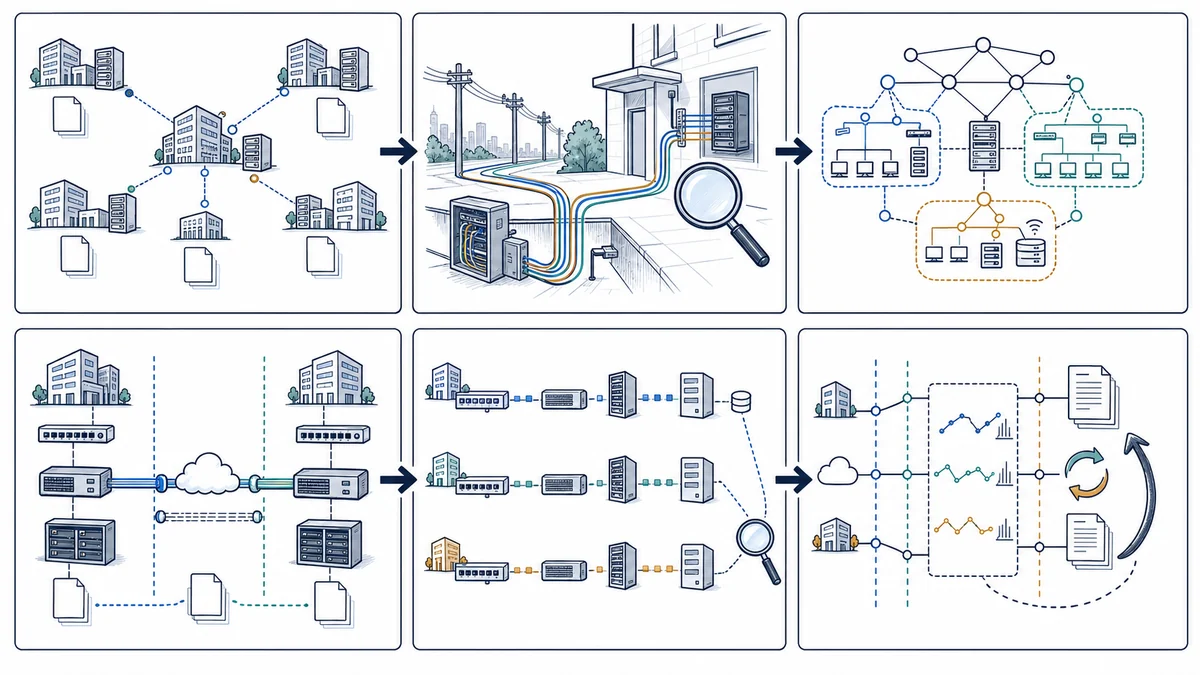
Multi-location connectivity should provide only the communication the business has approved. Network segments, routes, firewall zones, VPN selectors, user roles, administrative paths, and application permissions can limit unnecessary reach where the technology supports them. Extending a flat network between locations can enlarge the impact of a mistake or compromised system. Segmentation reduces some paths, but it does not replace endpoint protection, identity controls, application security, updates, backups, or user procedures.
Configuration standards can define naming, subnet records, VLAN purposes, gateway roles, management access, time sources, logging, configuration backups, approved firmware ranges, and change records. Exceptions should name the location, reason, owner, risk, and review condition. Sensitive credentials and keys belong in an approved secure system rather than a general network diagram.
Centralized monitoring may collect selected circuit, device, tunnel, interface, latency, or packet-loss indicators when the platforms and service scope support it. Collection depends on reachable devices, credentials, licensing, polling or telemetry, accurate time, retention, and notification delivery. Monitoring does not mean a person is continuously watching events or that someone will respond immediately. Recipients, review hours, thresholds, escalation steps, and maintenance responsibilities must be stated in the applicable arrangement.
Treat Backup Paths as Resilience Options With Shared Dependencies
A primary and backup circuit can reduce exposure to some access-circuit failures when edge equipment, routing, power, cabling, provider handoffs, addressing, and the application path support the design. The circuits may still share building entry, utility power, upstream infrastructure, conduit, carrier ownership, or regional conditions. A secondary wireless connection may have different coverage, data, addressing, and equipment constraints. Circuit diversity should be verified rather than inferred from two provider names.
Failover can change the public address, available bandwidth, latency, route, DNS behavior, VPN endpoint, or firewall state. Existing sessions may disconnect, and voice, video, large transfers, cloud allowlists, or site tunnels may behave differently on the alternate path. Planned testing can validate defined scenarios under observed conditions, but it cannot establish future carrier availability or fixed application performance.
Application experience depends on application design, server and cloud infrastructure, endpoint condition, local Wi-Fi or cabling, gateway capacity, internet paths, latency, packet loss, bandwidth, encryption overhead, and competing traffic. Measurements should record endpoints, direction, time, protocol, and load. One speed result at headquarters does not characterize a branch workflow or a remote provider path.
Plan New Locations, Acquisitions, and Consolidations Before the Move Date
New-location deployment may involve service-availability checks, circuit orders, demarcation details, landlord or building access, rack and power readiness, firewall and switch staging, Wi-Fi and cabling dependencies, addressing, identity, cloud access, phones, printers, vendor systems, and local acceptance testing. Carrier construction and activation dates are controlled by the provider, so temporary connectivity and schedule risk should be discussed without assuming either is available.
An acquisition or office consolidation adds discovery work. The incoming environment may use overlapping networks, separate identity domains, unsupported hardware, undocumented VPNs, unknown administrator accounts, conflicting security policies, or applications licensed to a particular address or organization. Connecting networks before understanding those conditions can introduce operational and security risk. A phased plan may keep selected environments separate while ownership, access, data flows, and migration decisions are confirmed.
Remote preparation can cover interviews, document and configuration review, staging, provider coordination, and supported changes when authorized management paths exist. Onsite work may be needed to verify carrier handoffs, power, racks, cabling, equipment labels, physical condition, wireless context, and local workflow results. Remote-site dispatch timing and third-party access remain subject to the location and approved scope.
Define What the Connectivity Project Includes
A Defined Project May Include
- Location, user, application, data-flow, carrier, equipment, ownership, and business-impact discovery
- Supported site-to-site VPN, internet-edge, addressing, routing, DNS, segmentation, and firewall planning
- Carrier and application-vendor coordination using customer-authorized contacts and account details
- Configuration standards, diagrams, circuit records, test plans, change windows, and rollback planning
- Staging, approved implementation, representative workflow testing, exception records, and handoff
- Selected monitoring configuration and escalation paths under a separately defined operating scope
It Does Not Automatically Include
- Internet circuits, carrier construction, provider repair, private-network services, licenses, or third-party fees
- Support for each carrier, country, platform, application, device, location, or unsupported product
- Uninterrupted failover, fixed uptime, a particular application speed, or carrier-independent operation
- Endpoint remediation, identity administration, application repair, cloud-provider engineering, or data migration
- Electrical work, construction, permits, property approval, or work reserved for another qualified trade
- Continuous human monitoring, a promised response time, or rapid onsite service at a remote location
The customer provides authorized access, accurate locations and business priorities, carrier account information, vendor contacts, supported licenses, property permissions, decision-makers, and appropriate testing and change windows. Apex can coordinate evidence and technical requirements, but a carrier, cloud provider, software vendor, building manager, or third-party administrator controls its own systems and schedule.
Assess, Design, Coordinate, Test, and Document the Connection
- Define the business paths. Record locations, users, applications, data flows, hours, critical workflows, security boundaries, growth plans, and tolerance for planned interruption.
- Inventory the environment. Review circuits, demarcations, gateways, firewalls, switches, addressing, routing, DNS, identity, cloud dependencies, licenses, ownership, support status, and available diagrams.
- Select a supportable architecture. Compare feasible internet, VPN, provider, and supported SD-WAN-category options against location availability, risk, operational ownership, performance needs, and lifecycle.
- Resolve prerequisites. Confirm circuit orders, administrative access, equipment, licensing, nonoverlapping networks, provider tasks, building access, application-vendor participation, and local hands where needed.
- Plan the change. Preserve supported configurations, document expected impact, schedule an appropriate window, define rollback and decision points, and identify authorized acceptance contacts.
- Implement the approved scope. Stage and apply supported gateway, VPN, firewall, route, DNS, monitoring, and related settings while recording authorized deviations.
- Test representative workflows. Validate intended and blocked routes, name resolution, identity, cloud and shared applications, voice or file activity where relevant, monitoring signals, and approved primary-to-backup path behavior.
- Hand off maintained records. Update diagrams, subnets, routes, circuit IDs, device roles, configurations, test results, exceptions, provider contacts, support ownership, and future change procedures.
Support for Orange County Headquarters, Branches, and Remote Sites
Apex IT Solutions serves businesses and organizations in Anaheim, Irvine, Santa Ana, Costa Mesa, Fullerton, Brea, Buena Park, and other Orange County communities where service is operationally available. An Orange County headquarters may coordinate with local branches, warehouses, leased offices, cloud services, or sites outside the county. Each location can have different carriers, building rules, equipment, staffing, vendors, and support access.
Share the addresses, important workflows, known circuits, current equipment, move or opening dates, and the people who own carrier and application relationships. That information helps separate remote work, Orange County site visits, and dependencies controlled by providers or remote-site resources.
Multi-Location Network Connectivity FAQs
What is the difference between site-to-site VPN and remote-user VPN?
A site-to-site VPN connects supported network gateways so approved ranges can communicate between locations. A remote-user VPN connects an authorized user device through a client or operating-system profile. The models have different identity, addressing, routing, endpoint, licensing, and administration requirements.
Do branch offices need a VPN if applications are in the cloud?
Not necessarily. Some cloud workflows can use direct internet access with suitable identity, endpoint, DNS, and edge controls. A VPN may still be needed for private systems or administrative paths. Requirements should be mapped application by application rather than extending headquarters access by default.
Will a backup internet circuit prevent an outage?
No. It may address selected circuit failures when equipment, routes, power, provider paths, and applications support the design. Shared conduit or upstream infrastructure, public-address changes, limited alternate bandwidth, and session behavior can still interrupt work. Defined failover scenarios should be tested.
What can cause poor application performance between locations?
Possible factors include latency, packet loss, limited bandwidth, competing traffic, Wi-Fi or cabling, gateway capacity, encryption, route choice, DNS, endpoint condition, server load, cloud infrastructure, and application design. Testing should use the actual workflow and record both network and application evidence.
Can existing locations use overlapping IP address ranges?
They can operate separately, but overlap complicates direct routing and site-to-site connectivity. Translation may be possible in selected designs, while renumbering may be cleaner for long-term operation. Either approach affects firewall rules, DNS, DHCP, static systems, monitoring, and documentation and requires review.
Does centralized monitoring include continuous human review?
No. Tools may collect selected indicators and send notifications when their dependencies work. Human review hours, recipients, thresholds, escalation, and response expectations belong in the service arrangement. A device responding to monitoring also does not prove that a business application is usable.
Can Apex coordinate with carriers and application vendors?
Apex may coordinate technical requirements, testing evidence, circuit details, and change timing when authorized. The provider controls its service, schedules, repair process, equipment, and final actions. The customer should supply account authority, current contacts, and decision-makers.
How should we prepare for a new branch or acquisition?
Provide locations, target dates, floorplans where available, carriers, equipment, addressing, identity, applications, vendors, security boundaries, site access, and business priorities. Early discovery helps identify circuit lead times, overlap, unsupported systems, ownership gaps, and a practical migration sequence. Request IT Support or call (800) 275-6513.
Plan the Business Paths Before the Next Site Opens or Changes
Share the locations, important applications, existing circuits and equipment, security requirements, known symptoms, and upcoming move, acquisition, or consolidation dates. Apex IT Solutions can assess supported options, identify carrier and technology dependencies, and prepare a controlled connectivity plan.